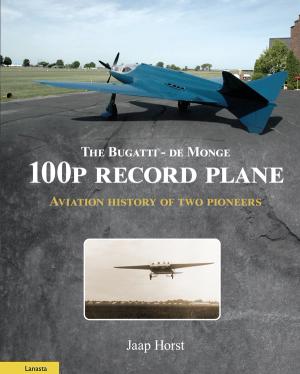
The development of this extremely advanced airplane with many novel features was starts in 1936,
when Ettore Bugatti hires the Belgian aerodynamicist and inventor Louis de Monge as chief engineer.
The first version of the airplane is planned as a speed-record airplane, a military version is
to follow later. Tragically the original Bugatti 100P airplane never flies, the Germans invade Paris
before construction is ready. The airplane surprisingly survives the war, and still exists in the EAA
museum in Oshkosh, USA. Engines that are in the airplane when found exist, are built into Bugatti
racecars. A flying replica was constructed in the USA, aerodynamically identical to the original.
Unfortunately, the replica crashes shortly after take-off of the 3rd flight, killing its pilot and builder
Scotty Wilson, and destroying the airplane.
This book describes the complete history of this wonderfully beautiful, streamlined airplane, as well
as all of its novel systems. The story of both the plane’s creators are followed, from the early years
of aviation in 1909, until after World War Two. Since the first two editions of this book, new details
have been added, info on airplane designs not known before, and a lot of new photographic material
came to light.
Ettore Bugatti is well known through his race- and sports cars from the years in between both world
wars. He is also involved in many other technical devices, including boats, bicycles and trains. During
the First World War airplane engines are designed and built. This book describes these engines
and derivatives in detail, showing also the airplanes using these engines, including the world’s first
fully functional “modern” helicopter. From around 1935 interest in aviation starts again, with several
new aero engine designs and culminating in the project to build the 100P airplane.
Louis de Monge builds his first airplanes before WWI, during and after that war he designs and produces
modern propellers, sold under the name Lumière. Many, often technically advanced, airplane
designs are made, and sometimes constructed. The complete history of his many interesting inventions
and lack of commercial success, during the half-century starting in 1909, is shown here.